What
Is MOA and
Is It Really an Inch At 100 Yards?
MOA stands for Minute Of Angle. A full circle
is divided into 360 degrees and each degree is divided into
60 minutes. Thus, there are 21,600 minutes in a full circle
(360 x 60 = 21,600). A minute is a small angle, but it's exactly
what's needed for gun sights. A rule of thumb is that changing
a sight's elevation setting by 1 minute of angle changes the
bullet's impact point by 1 inch at 100 yards. A more exact value
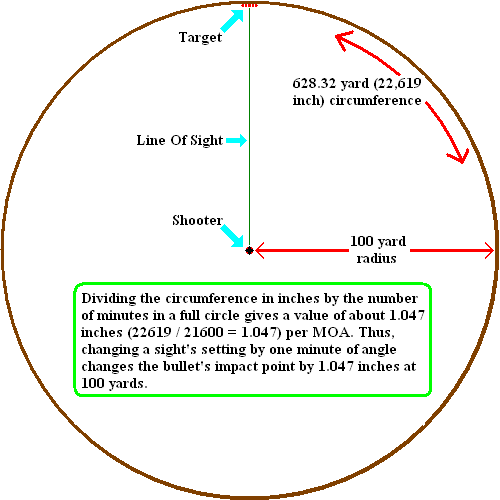
and how it's arrived at is shown below:
A circle with a 100 yard radius (distance from
the center to the edge) would have a circumference of approximately
628.32 yards or 22,619 inches (100 x 2 x pi = 628.32 {pi is
about 3.1416}). Dividing the circumference in inches by the
number of minutes in a full circle gives a value of about 1.047
inches (22619 / 21600 = 1.047). Thus, changing a sight's elevation
setting by 1 minute of angle changes the bullet's impact point
by 1.047 inches at 100 yards. And the bullet's impact point
would change by 2.094 inches at 200 yards (1.047 x 2) and change
by 3.141 inches at 300 yards (1.047 x 3).
G1 vs. G7 -- The Real Story The
Drag Analyzer shows bullet drag as a function of velocity and
reveals the real differences and similarities between the G1
and G7 drag functions. You can also watch
it on YouTube.
Modern Boresighting Tips We show
you how to get and use the free SiteLite BTS software
to print custom boresight targets and we give you tips on using
them for the most accurate results. You can also watch
it on YouTube.
Boresighting Tactical Rifle Sight Systems We show
you how to calibrate dual sight systems often used on tactical rifles
You can also watch
it on YouTube.
Custom Drag Functions Custom
drag functions claim much more accurate downrange predictions
than using simple G1 or G7 BC values. We put that claim to the
test. You can also watch
it on YouTube.
Drag Functions Synthesizer This
FREE software gives shooters
the ability to visually compare the drag characteristics of
many more Doppler radar tested bullets to G1 and G7. It's
like turning the lights on. You can also watch
it on YouTube.
Ballistic Explorer is a trademark of Dexadine, Inc. All other products mentioned
are registered trademarks or trademarks of their respective companies.